

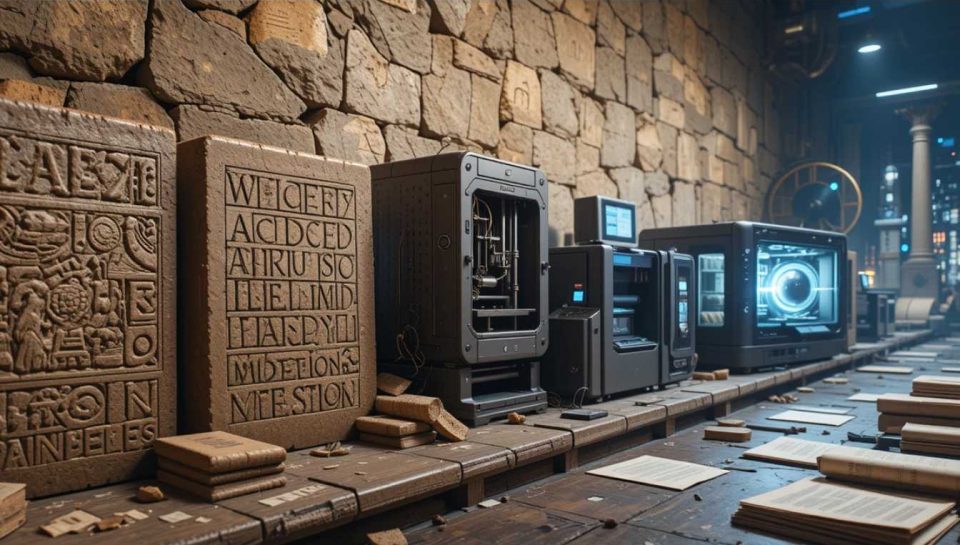
Printing Through the Ages: How Innovation Changed the World
Explore the evolution of printing, from ancient methods to modern technologies, shaping communication, education, and innovation across centuries.
The history of printing is a remarkable journey of innovation, fundamentally shaping how humans communicate, share knowledge, and build societies. From its earliest origins to today’s cutting-edge technologies, printing has played a crucial role in advancing civilization.
The Origins of Printing
Printing traces its roots to ancient civilizations. Early forms of printing appeared in Mesopotamia around 3000 BCE, where cylinder seals were used to create impressions on clay tablets. In China, during the Tang Dynasty (618-907 CE), woodblock printing emerged, enabling the reproduction of texts and images on paper and silk. One of the most notable examples of this technique is the Diamond Sutra, printed in 868 CE—the world’s oldest known printed book.
A major breakthrough came in the 11th century when Bi Sheng, a Chinese inventor, developed movable type using ceramic materials. This allowed for greater flexibility in printing texts, though the technology remained limited in its application. However, the real turning point came in 15th-century Europe with Johannes Gutenberg’s mechanical movable-type printing press.
Gutenberg and the Printing Revolution
Gutenberg’s press, developed around 1440, is widely regarded as one of history’s most transformative inventions. By combining metal movable type with oil-based ink, he created a system that enabled the mass production of books. His most famous work, the Gutenberg Bible, printed in the 1450s, showcased the precision and beauty of early printed materials.
This invention democratized access to information, breaking the monopoly of handwritten manuscripts that were once reserved for the elite. The printing press fueled the Renaissance and Reformation, accelerating the spread of new ideas and knowledge across Europe. As literacy rates rose, the demand for books, newspapers, and pamphlets surged, fundamentally changing how societies functioned.
According to the British Library (source), Gutenberg’s press dramatically reduced the cost of books and increased literacy rates, laying the foundation for modern publishing.
The Evolution of Printing Technologies
Over time, printing techniques continued to evolve. The 19th century saw the rise of steam-powered presses and rotary printing, significantly increasing the speed and volume of production. This paved the way for mass media, making newspapers and periodicals widely accessible.
In the 20th century, further advancements, such as offset printing and digital reproduction, enhanced the efficiency and affordability of printed materials. The introduction of photocopying and laser printing revolutionized office environments, making document duplication quick and easy. The late 20th and early 21st centuries witnessed even more innovation, with the rise of desktop publishing and, more recently, 3D printing, which extended the concept of printing beyond text and images to the creation of tangible objects.
The Smithsonian Institution (source) highlights how modern 3D printing is revolutionizing industries such as medicine and manufacturing, enabling the production of customized prosthetics, tools, and even entire buildings.
Why Printing Matters
Throughout history, printing has served as a cornerstone of communication, education, and cultural preservation. It has facilitated the documentation of scientific discoveries, making knowledge more accessible and fostering collaboration across disciplines. The printing press played a crucial role in the Enlightenment era, allowing philosophers and scientists to publish works that challenged conventional thinking and propelled intellectual progress.
In education, printed textbooks and learning materials have been instrumental in reducing barriers to knowledge. Beyond academia, printing has preserved literary and artistic heritage, ensuring that cultural masterpieces are passed down through generations. The ability to produce printed materials has also been vital to democracy, giving people access to diverse viewpoints and reliable information.
As Albert Einstein once said, “The only thing that you absolutely have to know is the location of the library.” This quote emphasizes the critical role of printed knowledge in education and human progress.
The Role of Printing in the Digital Age
Despite the rise of digital media, printing remains relevant across various industries. Books, magazines, and newspapers continue to be valued for their tangible, enduring nature, offering an experience that digital screens cannot replicate.
In business, printed materials—such as brochures, business cards, and product packaging—are essential for branding and marketing. In healthcare, accurate and durable printed labels, patient records, and instructional materials are crucial for maintaining clarity and safety.
Additionally, modern printing technologies have embraced sustainability and customization. On-demand printing minimizes waste by allowing companies to produce materials only as needed. Sustainable practices, such as eco-friendly inks and recycled paper, have also gained traction, reducing the environmental impact of mass printing. Meanwhile, 3D printing has transformed industries such as manufacturing, healthcare, and construction by enabling the production of complex, tailored objects with precision and efficiency.
The World Economic Forum (source) reports that 3D printing is helping reduce waste and energy consumption in the manufacturing industry, making it a key player in the future of sustainable production.
Final Thoughts
The evolution of printing is a testament to human ingenuity and the relentless pursuit of more effective ways to share information. From ancient carvings to today’s sophisticated digital and 3D printing methods, this technology has continuously adapted to meet society’s changing needs.
As we move forward in an era where print and digital media coexist, printing’s role remains vital. Whether in education, business, or creative expression, its ability to make ideas tangible ensures its enduring significance. The story of printing is not just about machines and techniques—it’s about the power of communication and the impact of accessible knowledge on human progress.